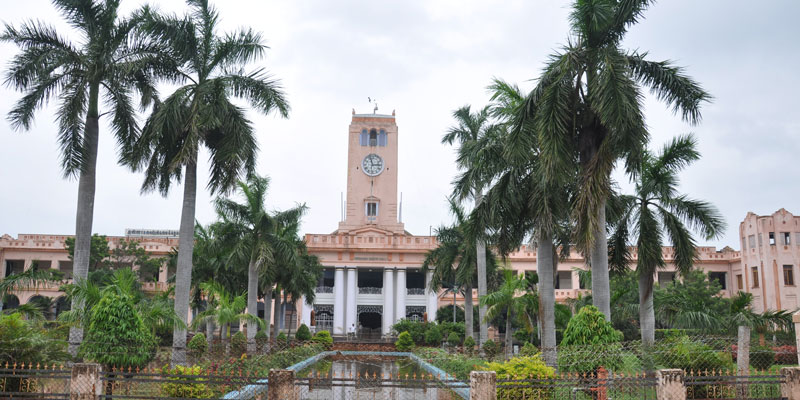
Annamalai University
| Quick View of Annamalai University | |||||||
| Established In | 1929 | ||||||
| Location | Tamil Nadu | ||||||
| University Type | State | ||||||
| Recognised By | UGC Approved|NAAC Accreditation|AIU Member | ||||||
| Number of Affiliated Institutes | 48 | ||||||
| Total Collaborations | 40 | ||||||
| Courses Offered | 500+ | ||||||
| Facilities | Library, GYM, Canteen, Lab, Sports, Wi-Fi, Medical | ||||||
Annamalai Institution (AU), India's first private university, has recently been designated as a 'State Government University.' The NAAC awarded it an 'A' grade in 2014, and it is recognised by the UGC. It is also a member of the Association of Indian Universities (AIU) and was ranked in the University category by NIRF in 2020, in the range of 101-150. Annamalai University currently has 48 affiliated institutes and offers UG, PG, PG diploma, diploma, certificate, and PhD programmes through its 10 faculties, which include Arts, Science, Indian Languages, Education, Agriculture, and Medicine.
Annamalai University has received 15 patents from various institutions, including the Food and Agriculture Organization of the United Nations (FAO), the International Rice Research Institute (IRRI), and the United States Department of Agriculture (USDA), and has signed 40 Memorandums of Understanding (MOUs) with research partners like FAO, IRRI, and USDA. Bayer, CavinKare, the Bill and Melinda Gates Foundation, Dow AgroSciences, Huawei, and other international organisations and industrial players collaborate on research projects at the university. The Department of Science and Technology has given it the PURSE (Promotion of University Research and Scientific Excellence) programme (DST).
In the early 1920s, to serve the downtrodden and to promote Tamil Literature, Rajah Sir S. R. M. Annamalai Chettiar founded Sri Minakshi College, Sri Minakshi Tamil College and Sri Minakshi Sanskrit College in a rural setup at Chidambaram. In 1928, Rajah Sir S. R. M. Annamalai Chettiar agreed with the local Government to hand over the above-said institution for establishing a University. Thus, on 01.01.1929 Annamalai University was established as per the Annamalai University Act 1928 (Tamil Nadu Act 1 of 1929).
Courses
Highlights
- The university holds 15 patents and 40 memorandums of understanding with research partners such as the FAO, IRRI, and USDA. MOU with Suriname's Technological University of the Americas
- MOU with FORBES Business School in Vijayawada and Sri Sankara Educational and Charitable Trust in Tripura's Tripurasundari College of Education.
- "The Times Higher Education World University Ranking - 2018" has ranked Annamalai University in the overall category at 801 - 1000, and in the life sciences category at 401 - 500. "The CWTS Leiden Ranking 2017" has ranked the University at 14th based on the number of publications.
- "The University was rated third in the CWTS Leiden Ranking 2017" on the scientific impact of universities and on universities' based on the proportion of publications.
- "Annamalai University was placed second among the Top 50 State Universities in Research Productivity by the CII in a report based on the "Indian Citation Index" Database.
- Annamalai University is ranked 11th among India's top 30 universities in "The Nielsen - India Today Ranking" (2017).
Annamalai University Ranking
- Times Higher Education World University Ranking-2021
- 1000+ (Overall)
- 601+ (Clinical & Health subjects)
- 801-1000 (Engineering)
- 801+ (Life Sciences)
1000+ (Physical Sciences)
- QS World University Ranking 301-350 (Asia ranking)
- CWTS Leiden Ranking 23 (number of publications)
Annamalai University Admission 2021
Annamalai University offers merit and entrance-based admissions. Reservation restrictions imposed by the Tamil Nadu government apply to online admissions. Every year, the University's academic calendar begins in August or September and includes semester-based examination and evaluation.
The application process for Annamalai University is done entirely online. Candidates who meet the qualifying requirements can apply online through the University's official website and pay a course-specific application fee. However, the hard copy of the submitted application form must be submitted to the University office in offline manner within the deadlines.
|
Courses |
Eligibility |
|
B.sc |
Passed Class 12 with Physics, Chemistry and Biology/ Botany & Zoology as compulsory subjects and a minimum of 40$ aggregate in total and 35% in English |
|
BE |
Passed Class 12 with a minimum of 45% aggregate |
|
M.sc |
A pass in BSc degree in relevant subjects with a minimum of 50% aggregate |
|
ME |
A pass in BE/ BTech degree in relevant stream from a recognised institution |
|
MBA |
Passed graduation degree in any stream with a minimum of 50% aggregate |
|
MA |
A pass in bachelor’s degree in relevant subjects |
|
MCA |
Bachelor’s Degree in any stream with Mathematics as a compulsory subject at HSC-level and a minimum of 55% aggregate |
|
Bpharma |
Passed Class 12 from a recognised board with Physics, Chemistry, Botany and Zoology or Physics, Chemistry, Biology/ Mathematics as main subjects with a minimum of 40% aggregate |
Annamalai University Courses & Fees
Annamalai University provides over 500 courses in ten disciplines, including Arts, Science, Marine Sciences, Indian Languages, Engineering & Technology, and more. Full-time and part-time distance-learning UG and PG programmes are available, with durations ranging from three to five years. The duration of diploma, post-graduate diploma, and certificate programmes varies from one to four years.
While the majority of the courses are taught in English, the University also provides a few courses in other languages, such as PGD Co-operative Management, Diploma in Agribusiness Management, Offset Machine Printing Certificate Program, BA History, and so on.
Both the English and Tamil languages are used. For prestigious courses such as BE and BPharm, lateral entry admissions are also available. The following are the top Annamalai University courses, together with their eligibility requirements and fee structure:
|
Courses |
Eligibility |
|
B.sc |
Rs 51,200- Rs 56,580 |
|
BE |
Rs 53,650- Rs 66,200 |
|
M.sc |
Rs 13,495- Rs 31,295 |
|
ME |
Rs 55,060- Rs 63,060 |
|
MBA |
Rs 58,260- Rs 61,200 |
|
MA |
Rs 7,095- Rs 7,595 |
|
Mpharm |
Rs 1.04 lakh |
|
Bpharma |
Rs 36,380 |
Annamalai University Placement 2021
Placements at Annamalai University are available in all departments. Annamalai University's Directorate of Training, Placement, and Entrepreneurship organises industrial tours, career fairs, soft skills training, and campus selection programmes for students with the support of placement officials. Many southern companies come to campus to recruit students for a variety of job responsibilities and opportunities.
Every year, more than 80% of qualified candidates are put on campus, with more than 50% of students placed in top-tier firms. The highest compensation for top courses is usually around Rs 10-15 LPA, with the average wage around Rs 2-3 LPA and the lowest salary around Rs 1-2 LPA.
Annamalai University Scholarship Scheme
Concessions on application fees: Are available for students who are from a minority group or who have converted to Christianity. The Government of Tamil Nadu offers students from the SC/ ST community and converted Christians a fee waiver for entrance/course application fees.
Concessions on tuition fees for SC/ST and Christian converts: The Government of Tamil Nadu provides full-tuition fee concession to students from the SC/ST group and converted Christians under rule 92 of the Tamil Nadu Education Rules.
Post-Matric Scholarship: Students from the SC/ ST community will be eligible for this scholarship, which will cover special fees, examination fees, and maintenance costs as long as their guardian's total annual income does not exceed Rs 50,000. (Rs 2.5 LPA for ST and Rs 2 LPA for converted Christians).
Higher Education Special Scholarships: Are provided to hostel students from SC/ ST and converted Christian groups who have an annual family income of less than Rs 2.5 lakh per annum. The government sets a restriction on the number of scholarships available.
Fee concession for blind students: Under this scheme, blind pupils, regardless of community, receive complete tuition fee concession if their yearly parental income does not exceed Rs 24,000 per year.
Scholarships for women pursuing a postgraduate degree: This scholarship is given to PG students from the SC/ ST community who are studying in the Arts/ Science faculty.
First Graduate Tuition Price Concession: The Tamil Nadu government has ruled that candidates who would be the first graduate in their family receive a tuition fee reduction.
Facilities

Ransomware by ./M789

Hostel

Sports Complex

Gym

Medical Facilities

Wi-Fi Campus

Auditorium

Labs
Contact
Annamalai University, Annamalainagar - 608002 Tamil Nadu India
-
PGDM-Post Graduate Diploma in Management
Total Fee: INR 745000
-
B.Com Bachelor of Commerce
Total Fee: INR 240000
-
PGDM-Post Graduate Diploma in Management
Total Fee: INR 745000
-
B.Com Bachelor of Commerce
Total Fee: INR 240000
-
PGDM-Post Graduate Diploma in Management
Total Fee: INR 745000
-
B.Com Bachelor of Commerce
Total Fee: INR 240000
-
PGDM-Post Graduate Diploma in Management
Total Fee: INR 745000
-
B.Com Bachelor of Commerce
Total Fee: INR 240000
Highlights
- International Institute of Business Studies (IIBS) is an AICTE Approved college which is recognized by Ministry of HRD, Government of Indias
- IIBS rated India’s No.1 emerging B-School in placement by Samaja Parivarthana
- Faculty of IIBS consists of experienced corporate faculty with 65% Ph.D. holders
- Ranked 2nd among 'Top 10 Southern B Schools' by Silicon India, 2017
- Ranked 3rd in Placement among the Best B-School in India 2017 by Silicon India
Modern Facilities
- Smart Classroom: IIBS provides fully equipped classroom with air-conditioned, projectors, remote controlled LCD and high speed connected computers and cordless microphones
- Library: It is fully equipped by highly information recourses like latest periodicals, reference texts, management text books, national and international journals and DVDs and well organized
- Digital Library: Students of IIBS can be access the digital library through any computers by using their ID and password
- Auditorium: IIBS auditorium is fully furnished and laced with all modern devices to more impactful view
- Hostel: IIBS provides hostel accommodation for boys and girls with mesh facility
Conducting IIMs have been changed the pattern of the CAT exams several times over the years. It is extremely beneficial for the aspirants to know the CAT paper pattern as it helps in preparation and the aspirants can prepare according to the pattern and weightage of the topics.
Overview of the Exam Pattern of CAT 2020
| Mode of the Exam | Online Only |
|---|---|
| Total number of Questions | 100 |
| Total Marks | 300 |
| Duration of the Examination | 3 hours (180 minutes) |
| Sectional Division of the Paper | 3 sections |
| Types of the Questions | Both MCQs and Non MCQs |
| Marking Scheme |
For Correct Answers → +3 marks For Incorrect Answers → -1 mark For Unattempted Questions → No marks |
| Name of the Sections |
1. Verbal Ability & Reading Comprehension 2. Logical Reasoning & Data Interpretation 3. Quantitative Aptitude |
This Exam is conducted once in a year usually in the month of November on online mode and it is expected that this year this exam will held in the last week of November. The question paper contains 100 questions to be solved in 3 hours. 3 marks are assigned for correct answer and 1 mark is deducted for wrong answer in CAT Exam. English is the only medium of answering the questions. Each question consists of four choices from which only one is correct, candidates have to select the right answer from the given options.
CAT question paper consists of three sections divided as
- 1. Verbal and Reading Comprehension (VARC)
- 2. Data Interpretation & Logical Reasoning (DI & LR)
- 3. Quantitative Ability (QA)
Overview of the Exam Pattern of CAT 2020
| Section’s Name | Number of Questions | Duration (in mins) |
|---|---|---|
| Verbal and Reading Comprehension (VARC) | 34 | 60 |
| Data Interpretation & Logical Reasoning (DI & LR) |
VA → 10 Questions RC → 24 Questions |
60 |
| Quantitative Ability (QA) |
DI → 16 Questions LR → 16 Questions |
60 |
| Total | 100 | 180 minutes (3hours) |
Verbal Ability and Reading Comprehension Section
This section is a combination of two sub-sections namely Verbal Ability (VA) and Reading Comprehension (RC). The main focus of this section is on the English language skills of the candidates and how they understand and elucidate the paragraphs and Passages. This section consists of 34 questions, 10 questions of Verbal Ability and 24 questions of Reading Comprehension. Verbal ability sub-section consists of questions related to Para-jumbles, Summary based questions, Sentence Correction and Completion. The other sub-section, Reading Comprehension is based on the questions related to Vocabulary, title etc.
Logical Reasoning & Data Interpretation Section
This section is also divided into two sub-sections, one is Logical Reasoning (LR) and other is Data Interpretation (DI). A total of 32 questions are asked in this section, 16 questions from both the sub-section. LR section contains solvable questions generally from the topics like inequalities, symbol operations, direction sense test etc. On the other hand DI section is a little difficult and time-consuming section as it consists of several confusing data case lets questions. This section contains tricky question and a little mistake in understanding the case lets can lead the candidates to attempt all the questions from a particular set incorrectly.
Quantitative Aptitude Section
This section is a standalone section which comprises only numerical questions from different topics of Math. A total of 34 questions are asked in this section. This section contains questions based on Basic Arithmetic, Number System, Geometry, Algebra, Modern Math etc. The questions in this section ranges from easy to moderately high and can be answered easily with proper practice of the syllabus of Quantitative Aptitude.
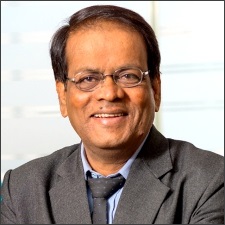
|
Prof. Prabhakar H
B.Sc., PG in HRD, PG in Training & Development |
|
|
Prof. Prabhakar H
B.Sc., PG in HRD, PG in Training & Development |
|
|
Prof. Prabhakar H
B.Sc., PG in HRD, PG in Training & Development |
|
|
Prof. Prabhakar H
B.Sc., PG in HRD, PG in Training & Development |
|
|
Prof. Prabhakar H
B.Sc., PG in HRD, PG in Training & Development |
|
|
Prof. Prabhakar H
B.Sc., PG in HRD, PG in Training & Development |
Facilities


CAT 2020 will be conducted in the following cities:
| Port Blair | Kurnool | Nellore | Tirupati |
| Vijaywada | Visakhapatnam | Chittoor | Itanagar |
| Dibrugarh | Guwahati | Silchara | Aurangabad |
| Gaya | Muzaffarpur | Patna | Chandigarh |
| lorem | lorem | lorem | lorem |
Contact Us
#75, Muthugadahalli, Bangalore North Jala Hobli, near International Airport airport(New Airport), Bangalore ( Karnataka)
admission@iibsonline.com


