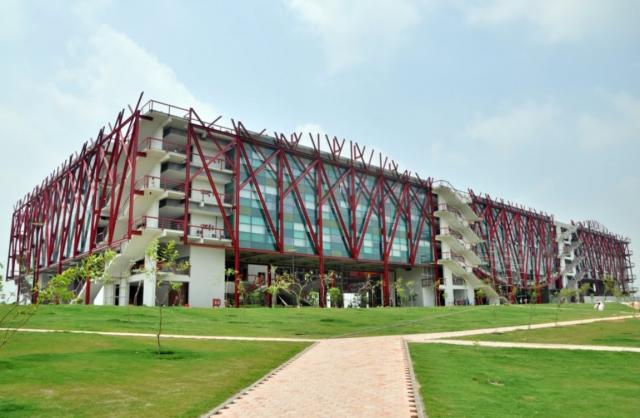
O.P Jindal School of Languages and Literature Sonepat
The Jindal School of Languages and Literature (JSLL) stands at the forefront of the university's mission to excel in the study of languages, literature, linguistics, and related cultural explorations. Language plays a vital role in everyday cultural experiences, helping us understand ourselves and others. In today's world, particularly in India, it is common to find people who are bilingual or trilingual, using both global and local languages.
If you have a passion for words, texts, and communication, and are curious about how different languages shape human understanding, JSLL is the perfect place for you. As an undergraduate, you can join our flagship programs, the BA (Hons.) English or BA (Hons.) English with Research. If you are enrolled in another program at the university, you can still explore JSLL's diverse elective courses, covering a wide range of subjects such as English drama, poetics, linguistics, the history of English literature, comparative literature, genre studies (including the graphic novel and science fiction), professional writing, editing and publishing, translation studies, literature and cinema, and more.
Additionally, JSLL offers instruction in languages beyond English, giving you the opportunity to engage with the cultural richness of Spanish and other world languages.
Highlights
|
Name of the School |
O.P Jindal School of Languages and Literature |
|
Location |
Sonepat |
|
Established year |
2021 |
|
Recognition |
UGC |
|
Accredited by |
NAAC A Grade |
|
AIU Membership |
Yes |
|
Top recruiting companies |
Wipro, TCS, Google, HCL, L&T, among others |
|
Total collaborations |
325+ International Collaborations |
O.P Jindal School of Languages and Literature Sonepat Courses
The B.A. (Hons.) English (Language and Literature) program at the Jindal School of Languages and Literature offers a meticulously crafted curriculum that emphasizes two key aspects. First, the program is designed to help students achieve proficiency in the English language, a vital skill in today’s globalized world where English serves as a widely spoken and essential means of communication.
- B.A. (Hons.) English
O.P Jindal School of Languages and Literature Sonepat Admission
The admission process for the Jindal School of Languages and Literature (JSLL) involves registration and application evaluation. Prospective students must follow the steps outlined below to secure admission:
Step 1: Application Process 2024
- Candidates must apply online via the official JSLL website. The application fee is INR 2,500. For further details, including the fee structure, students can refer to the provided resources on the website.
Step 2: Selection Rounds
- Selection is based on a thorough evaluation of the application form, which includes the candidate's personal statement, performance in an online entrance test or recognized national/international exams, and a personal interview (PI). The institute accepts scores from CUET, JSAT, SAT India, ACT, UGAT, and LSAT-India.
Step 3: Merit List and Admission Confirmation
- After the selection process, a merit list is published. To confirm their seat, selected candidates must pay the admission fee at the designated admission receipt center.
O.P Jindal School of Languages and Literature Sonepat Eligibility
To be eligible for the B.A. (Hons.) English program at the Jindal School of Languages and Literature (JSLL), applicants must have successfully completed their Class XII or an equivalent examination recognized by the government, such as CBSE, State Boards, IB, or Cambridge. Students from all academic streams—Arts, Commerce, and Science—are encouraged to apply.
Admission to the program follows a three-round process that evaluates multiple factors, including the applicant’s personal statement, responses to supplemental questions, Class 10 and 12 marks, performance in a faculty interview, and a qualifying score in JSAT, SAT, or ACT.
|
Courses |
Duration |
Eligibility |
|
B.A. (Hons.) English |
4 years |
10+2 Exam: JSAT/SAT/ACT |
O.P Jindal School of Languages and Literature Sonepat Fees
During the Jindal School of Languages and Literature (JSLL) admissions, candidates have the option to pay the fees either annually or semester-wise, based on the requirements. However, certain components, such as the one-time fees, are paid only once. The table below outlines the total tuition fees for all courses offered at JSLL. Students who wish to calculate the annual fee can divide the total amount by the number of years the course lasts. For semester-wise fees, they can divide the total by twice the number of years the course is valid.
|
Courses |
Duration |
Fees Per Annum |
|
B.A. (Hons.) English |
4 years |
3,00,000/- |
O.P Jindal School of Languages and Literature Sonepat Ranking
- Ranked as the No. 1 private university in India by the QS World University Rankings 2023 for the third consecutive year.
- The only Indian private university featured among the top 150 in the QS Young University Rankings 2022 for universities under 50 years of age.
- Jindal Global Law School (JGLS) has been named the No. 1 law school in India by the QS World University Rankings by Subject 2024, marking the fifth consecutive year of this achievement.
- Ranked among the top 250 universities globally for faculty-student ratio (1:9) and placed in the top 450 worldwide for employer reputation.
- Ranked within the top 550 universities globally for international faculty, with 14% of the total faculty being international.
O.P Jindal School of Languages and Literature Sonepat Recruiters
|
American Express |
Kotak Bank |
|
EY |
ICICI Prudential |
|
Maruti Suzuki |
ICICI |
|
pwc |
HDFC Bank |
|
Edelweiss Securities |
Dabur |
Faculty (7)
';|
S.no |
Faculty |
|
1. |
Prof. (Dr.) Denys P. Leighton Dean |
|
2. |
Dr. Kanupriya Dhingra Assistant Professor of English, JSLL |
|
3. |
Prof. Akshay Kale Assistant Professor of Spanish, JSLL |
|
4. |
Dr. Turni Chakrabarti Assistant Professor of English, JSLL |
|
5. |
Dr. Angana Moitra Assistant Professor of English, JSLL |
|
6. |
Prof. Neus Gimeno Gimeno Assistant Professor of Spanish, JSLL |
|
7. |
Dr. Nida Arif Assistant Professor of English, JSLL |
Facilities

AC Classrooms

Auditorium

Banks Facilities

Cafeteria

Convenience Store

Hostel

Labs

Medical Facilities

Wi-Fi Campus

Sports Complex
-
PGDM-Post Graduate Diploma in Management
Total Fee: INR 745000
-
B.Com Bachelor of Commerce
Total Fee: INR 240000
-
PGDM-Post Graduate Diploma in Management
Total Fee: INR 745000
-
B.Com Bachelor of Commerce
Total Fee: INR 240000
-
PGDM-Post Graduate Diploma in Management
Total Fee: INR 745000
-
B.Com Bachelor of Commerce
Total Fee: INR 240000
-
PGDM-Post Graduate Diploma in Management
Total Fee: INR 745000
-
B.Com Bachelor of Commerce
Total Fee: INR 240000
Highlights
- International Institute of Business Studies (IIBS) is an AICTE Approved college which is recognized by Ministry of HRD, Government of Indias
- IIBS rated India’s No.1 emerging B-School in placement by Samaja Parivarthana
- Faculty of IIBS consists of experienced corporate faculty with 65% Ph.D. holders
- Ranked 2nd among 'Top 10 Southern B Schools' by Silicon India, 2017
- Ranked 3rd in Placement among the Best B-School in India 2017 by Silicon India
Modern Facilities
- Smart Classroom: IIBS provides fully equipped classroom with air-conditioned, projectors, remote controlled LCD and high speed connected computers and cordless microphones
- Library: It is fully equipped by highly information recourses like latest periodicals, reference texts, management text books, national and international journals and DVDs and well organized
- Digital Library: Students of IIBS can be access the digital library through any computers by using their ID and password
- Auditorium: IIBS auditorium is fully furnished and laced with all modern devices to more impactful view
- Hostel: IIBS provides hostel accommodation for boys and girls with mesh facility
Conducting IIMs have been changed the pattern of the CAT exams several times over the years. It is extremely beneficial for the aspirants to know the CAT paper pattern as it helps in preparation and the aspirants can prepare according to the pattern and weightage of the topics.
Overview of the Exam Pattern of CAT 2020
| Mode of the Exam | Online Only |
|---|---|
| Total number of Questions | 100 |
| Total Marks | 300 |
| Duration of the Examination | 3 hours (180 minutes) |
| Sectional Division of the Paper | 3 sections |
| Types of the Questions | Both MCQs and Non MCQs |
| Marking Scheme |
For Correct Answers → +3 marks For Incorrect Answers → -1 mark For Unattempted Questions → No marks |
| Name of the Sections |
1. Verbal Ability & Reading Comprehension 2. Logical Reasoning & Data Interpretation 3. Quantitative Aptitude |
This Exam is conducted once in a year usually in the month of November on online mode and it is expected that this year this exam will held in the last week of November. The question paper contains 100 questions to be solved in 3 hours. 3 marks are assigned for correct answer and 1 mark is deducted for wrong answer in CAT Exam. English is the only medium of answering the questions. Each question consists of four choices from which only one is correct, candidates have to select the right answer from the given options.
CAT question paper consists of three sections divided as
- 1. Verbal and Reading Comprehension (VARC)
- 2. Data Interpretation & Logical Reasoning (DI & LR)
- 3. Quantitative Ability (QA)
Overview of the Exam Pattern of CAT 2020
| Section’s Name | Number of Questions | Duration (in mins) |
|---|---|---|
| Verbal and Reading Comprehension (VARC) | 34 | 60 |
| Data Interpretation & Logical Reasoning (DI & LR) |
VA → 10 Questions RC → 24 Questions |
60 |
| Quantitative Ability (QA) |
DI → 16 Questions LR → 16 Questions |
60 |
| Total | 100 | 180 minutes (3hours) |
Verbal Ability and Reading Comprehension Section
This section is a combination of two sub-sections namely Verbal Ability (VA) and Reading Comprehension (RC). The main focus of this section is on the English language skills of the candidates and how they understand and elucidate the paragraphs and Passages. This section consists of 34 questions, 10 questions of Verbal Ability and 24 questions of Reading Comprehension. Verbal ability sub-section consists of questions related to Para-jumbles, Summary based questions, Sentence Correction and Completion. The other sub-section, Reading Comprehension is based on the questions related to Vocabulary, title etc.
Logical Reasoning & Data Interpretation Section
This section is also divided into two sub-sections, one is Logical Reasoning (LR) and other is Data Interpretation (DI). A total of 32 questions are asked in this section, 16 questions from both the sub-section. LR section contains solvable questions generally from the topics like inequalities, symbol operations, direction sense test etc. On the other hand DI section is a little difficult and time-consuming section as it consists of several confusing data case lets questions. This section contains tricky question and a little mistake in understanding the case lets can lead the candidates to attempt all the questions from a particular set incorrectly.
Quantitative Aptitude Section
This section is a standalone section which comprises only numerical questions from different topics of Math. A total of 34 questions are asked in this section. This section contains questions based on Basic Arithmetic, Number System, Geometry, Algebra, Modern Math etc. The questions in this section ranges from easy to moderately high and can be answered easily with proper practice of the syllabus of Quantitative Aptitude.
|
Prof. Prabhakar H
B.Sc., PG in HRD, PG in Training & Development |
|
|
Prof. Prabhakar H
B.Sc., PG in HRD, PG in Training & Development |
|
|
Prof. Prabhakar H
B.Sc., PG in HRD, PG in Training & Development |
|
|
Prof. Prabhakar H
B.Sc., PG in HRD, PG in Training & Development |
|
|
Prof. Prabhakar H
B.Sc., PG in HRD, PG in Training & Development |
|
|
Prof. Prabhakar H
B.Sc., PG in HRD, PG in Training & Development |
Facilities


CAT 2020 will be conducted in the following cities:
| Port Blair | Kurnool | Nellore | Tirupati |
| Vijaywada | Visakhapatnam | Chittoor | Itanagar |
| Dibrugarh | Guwahati | Silchara | Aurangabad |
| Gaya | Muzaffarpur | Patna | Chandigarh |
| lorem | lorem | lorem | lorem |
Contact Us
#75, Muthugadahalli, Bangalore North Jala Hobli, near International Airport airport(New Airport), Bangalore ( Karnataka)
admission@iibsonline.com


